



Four bands on making music and finding a stage
Ahead of Bloody Autumn: Last Fall on 21 November, Okovi, Ciroza, Nexvs and Horizons talk to Lia about rehearsal rooms,…


The new school year rolled in and, in all the chaos and confusion of the renovations at TRAP, along came the cherry on top. A bunch of foreigners on an international volunteering programme got it into their heads to move to central Sofia on all of 600 leva a month so they could come and help out at TRAP. And it’s not just the people at TRAP who are a bit of a jumble. These four are quite the mix. Eetu, 30, comes from Finland. He’s been through addiction, an experience he now puts to use at YAD – Youth Against Drugs, the Finnish organisation working to prevent addiction among young people. Iris, 22, from Italy, is wondering what to do for her master’s. She already has a bachelor’s in translation and interpreting in Portuguese, Italian and English. Sara, 19, from Sweden, has just finished high school and came to Bulgaria with her university textbooks and all. And Izabela, 26, from Poland, has been married and divorced already, and loves going wild to metal just as much as she loves chanting ‘Hare Krishna, Hare Rama’. You get the idea. At least we’re having fun.
We decided to interview them so you could get to know them a little better – what brought them here, what excites them and how they see things.

For a first interview, this one with Iris, from Italy, isn’t all that spectacular, but here it is anyway:
K: Why did you pick Bulgaria?
I: I picked Bulgaria because Deyan messaged me on the ESC portal, told me about the project and invited me to come and volunteer. I said yes… So you could say I chose the project more than I chose Bulgaria.
K: How’s it going so far?
I: It’s a little stressful at the moment because there’s so much to do. At first everything was dirty and all over the place, so we had to get it all organised. It was hard, it took ages and it was exhausting. But now I’m really proud of what we’ve done. It feels good when you look at the results of your work. So things are fine now. And I’m a bit surprised at how quickly I’ve got used to a different way of life. That’s partly down to the other volunteers. I feel good and I’m looking forward to seeing what happens next.
K: What about when you’re away from TRAP? What do you do in your free time?
I: Mostly I go to cafés and drink coffee – no, wait, I also wander around looking for nice restaurants, spend time with the other volunteers… I went on the Free Sofia Walking Tour, which was really nice, you know, getting to know the city a little.
K: What are you into? Tell them what you studied.
I: Well, I have a bachelor’s degree in interpreting and translation in German, English and Portuguese… I love languages and I hope I can learn Bulgarian one day too. I like reading, Netflix… and chill, and clothes.
K: OK, what have you done for TRAP so far? Any projects or events?
S: Yeah, besides the everyday stuff, I decided to run an event about Italy, its culture, language and traditions. The other three will do the same for their countries. I feel like sharing a bit about us and where we come from is a good way to get to know the TRAP crowd and help them understand us.
K: So what have you got planned for the future?
I: I’d love to visit Bucharest and Istanbul, maybe Thessaloniki too, since Sofia’s in the middle of the Balkans. I’d be happy to climb a few mountains, though I’m not that bothered. My friends want to go camping and hiking, but personally I’m not all that excited about the idea… Stop looking at me like that, Sara.

Which brings us to Sara Eskelinen, 19, from Sweden, the girl who suggested going to the mountains:
K: Why Bulgaria?
S: Well, I was in Romania and I would’ve stayed there if I could have. But I couldn’t, so when I got an offer from Bulgaria I decided to come here.
K: Yeah, I’m not sure there’s any point asking what you like about Bulgaria now. You basically just said, ‘Well, I had no choice. Deyan made me. He was in Romania and stuffed me in his car and now I’m here, haaa.’
S: Yeah, that’s exactly how it happened. Seriously though, I like the people, the culture and the mountains.
K: What do you like about the people?
S: I like that they’re nicer and friendlier. People here are generally more talkative, warm, or maybe just more open to having a conversation. They seem a little closer to you.
K: Can you think of a particular time when you felt that?
S: Like when you go out to eat or just take a walk in the park, people actually talk to you. They’re willing to make contact. And I feel comfortable going up to a complete stranger and asking for help or just talking to them. People are more open generally.
Next up, a very exciting segment on how Sara loves dogs.
K: Right. What’s made the biggest impression on you in Bulgaria so far?
S: Well, I haven’t been here that long… I liked the park, and the DOGS! The dogs in the park! You’re allowed to pet any dog you like! I’ve met so many sweet dogs!
K: You don’t meet dogs like that in Sweden?
S: No, we’re not really supposed to touch other people’s dogs. But here the dogs come to you and you go to them.
K: They’re willing to make contact.
S: And you can pet them!
K: They’re Bulgarian dogs.
S: Yes, and there are golden retrievers everywhere. That’s one of my favourite breeds. I’m very happy about the dogs.
End of segment.
K: OK, what are you interested in? What are you planning to study at university?
S: I’d like to study a bit more earth science, but… that’s not going so well, so let’s just say I like hiking. That’s something I want to do in Bulgaria too. I’m planning to get out into the mountains a bit later on.
K: What else could you tell us so we can get to know you? A little better. What kind of person are you? I know you care a lot about the environment, so you could tell us something about that.
S: Oh! First I want to tell you my favourite colours are yellow and green. I like eating mushrooms too. But yes, when I go to the supermarket I usually try to take a container for whatever I want to buy so they don’t have to give me a new one and waste plastic or whatever. I’ve been recycling in Sweden for ages, since I was 15 actually. I started cooking for myself around then too, so that’s when I got into the habit of shopping responsibly. Recycling is one of the foundation’s causes, which I think is really good. I’ve already been to the National High School of Mathematics and Science once to pick up the waste and there was so much of it…
K: Tell us a bit more about what drew you to volunteering in the first place. Not just in Bulgaria, but in general.
S: I decided to volunteer for a summer. Basically my certificates were no longer valid and I had to learn everything all over again. I went to Romania for a break from studying and to try volunteering abroad. Then I got the offer from Bulgaria and thought, why not be in Bulgaria while I do this? So I’m in Bulgaria and studying at the same time. Part of it was getting away from the system in Sweden. But I’d always wanted to volunteer, which is why I signed up for the European Solidarity Corps a few years ago. I never got an offer until the people in Romania wrote to me. It was partly chance.
Some people are looking for an experience that adds a little variety to everyday life while they get on with other things that matter to them. Some just end up in Bulgaria because that’s where the wind blows them. And that’s perfectly fine and normal.
But it turns out someone was behind TRAP and its ideas right from the moment she saw the ad on the ESC (European Solidarity Corps) website. Meet Izabela, 26, from Poland.

K: So, now you can say whatever you like.
I: Ha, whatever I like?
K: I won’t put everything on the website (a downright lie), so it’s fine. Come on… OK, I know you’re already involved in a few things, like that refugee camp. Can you tell me a bit more about what’s happening there?
I: I don’t really know that much about it. Boyan told me he was a musician, we got talking, and at some point the camp came up. He’s going to run something like workshops for the refugees. They’ll make musical instruments out of different things, stuff people throw away and so on. I really want to go. I love music, I love making things, so I love events like that. And if it’s a chance to meet new people and try things I’ve never done before, I’m all for it.
K: Can you see that kind of thing happening at TRAP? Does TRAP feel like a creative place, somewhere for all those things you just said you liked?
I: Yes, that’s why I’m here. If there weren’t any creativity in this place, I wouldn’t be here. That was the main thing for me. To look for motivation and ways I can motivate others. Also to break the rules, the basic rules – school rules, for example, because I hate the whole idea of them. To find a way of making connections by doing something as a team and just being active with other people. So… that’s why.
K: That sounds really good.
I: I’ve been looking for a project like this for ages, and this one seems the best fit, mainly because of Deyan. He’s creating this place and what he has in mind is very close to my own idea.
K: Last question. How would you describe yourself? What kind of person are you? What matters most to you?
I: I’m not really sure, but sometimes when people ask me to describe myself in one word, I say improvisation. There was another word I can’t remember now… Anyway, yeah, improvisation. I like being flexible. I don’t like schedules, like ‘this has to be done at this time, followed by this and then that…’. Life goes on and at any moment someone might turn up with surprising news that wrecks your plans. But it might also open up new and interesting paths that could change everything, and I’m ready for that.
And that was Izabela.

I’ve saved Eetu from Finland for last, which has nothing to do with how much he means to TRAP or what he’s like as a person. He’s older, he’s been through a lot and knows about a lot of things that interest me. Now he’s found a chance to bring some of what shaped his work and his life in Finland here.
K: Tell us a bit about your life and your work.
E: It’s a long story. For a long time I was trying to find myself. I didn’t know what I could do with my life or what kind of person I might become.
I started taking drugs very young, so I was on the wrong track right from the start. I studied a lot over the years. I had good grades in high school before I started having to change schools because of my problem. I worked in ten different places. I was taking so many substances that I couldn’t stay anywhere very long.
I quit drugs for good about four years ago and alcohol about three years ago. Once I’d managed to deal with my own problems, I wanted to help other people do the same, or at least keep them from going down that road in the first place. I wanted to make a difference. What appealed to me most was sharing my experience with young people. I got the chance to work in a high school doing drug education. So I’ve been telling kids my story for years now.
K: What was student welfare like there? As I understand it, there were times when those schemes really helped you get by.
E: Oh, well, anyone can come to Finland and get some money from the government, so quite a few people take advantage of that solidarity. You don’t even have to be a citizen to get that money, so as a refugee you can build up some funds too. There are lots of laws in Finland and if you know how to use them you can live there quite comfortably.
K: So why Bulgaria? Why TRAP?
E: I’d been volunteering at YAD for years and someone there sent me information about a project in Croatia that sounded good. I opened the website to look at the ad and spotted Deyan’s invitation to volunteer with his youth organisation instead. One video chat with him and I knew straight away that I wanted to sign up and come here. I believe that when an opportunity like that crosses your path, you should reach out and grab it. I was also at a point in my life where I could spend a year in another country. I’m single, I’m not studying, and I can take a break from work and pick it up later, whenever I want. And I’ll turn 30 soon, so this is my last chance to do a longer project like this.
So those are our volunteers. They’ve already met and talked to lots of the kids and adults who come to TRAP every day. They’ve explored the city centre and started hunting high and low for cultural experiences in the capital and beyond. They spend their time on paperwork, sorting out the website and the Facebook and Instagram pages, sweeping the entrance and the rooms inside. They also share, talk and get to know people, putting on down-to-earth little events at Trotoara HQ and getting ready for the ones still to come. We’re glad they’re here and grateful for all the help they give us. Now it’s your turn to meet them.

This post is also available in: Bulgarian
Ahead of Bloody Autumn: Last Fall on 21 November, Okovi, Ciroza, Nexvs and Horizons talk to Lia about rehearsal rooms,…
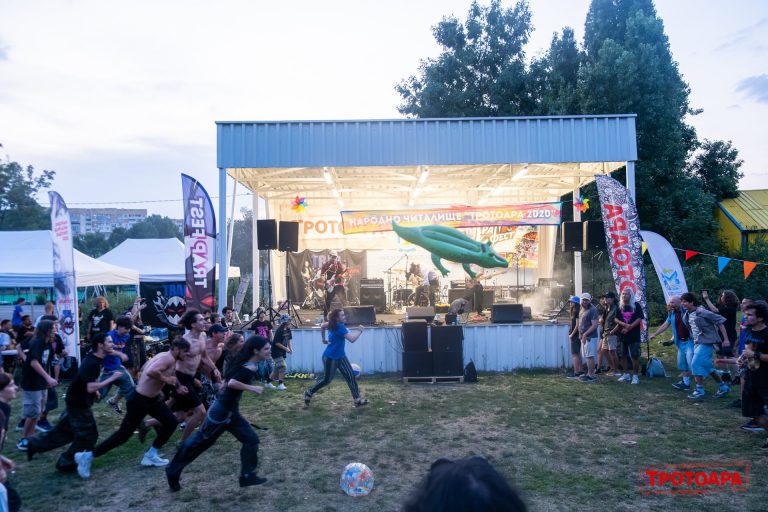
A closer look at the tenth edition A summer evening at TRAP Fest, 27 June 2026. On 14 June, setup…
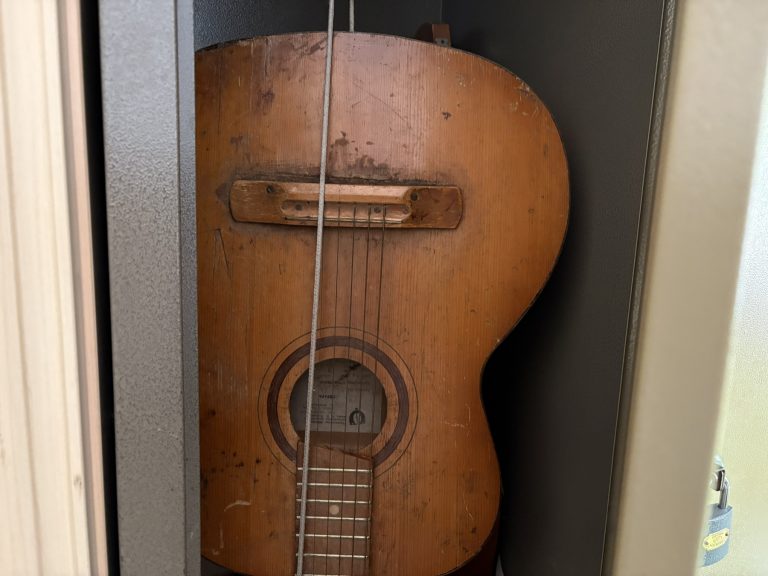
Deyan “Dido” Yankov on the tenth edition of TRAP Fest The guitar is still in the metal cabinet in my…
