




Four bands on making music and finding a stage
Ahead of Bloody Autumn: Last Fall on 21 November, Okovi, Ciroza, Nexvs and Horizons talk to Lia about rehearsal rooms,…


The community centre’s governing bodies are:
GENERAL ASSEMBLY
BOARD OF TRUSTEES
SUPERVISORY COMMITTEE
The highest authority of the community centre is the General Assembly. It consists of all members entitled to vote.
The executive body is the Board of Trustees, made up of at least three members elected for up to three years. They must not be related in the direct or collateral line up to the fourth degree.
The chair is a member of the board, elected by the General Assembly for a term of up to three years.
The secretary represents the centre jointly with the chair or independently.
The Supervisory Committee has at least three members elected for up to three years. It monitors whether the board, chair and secretary comply with the law, the centre’s charter and the decisions of the General Assembly.

Do you do anything besides your work at Trotoara?
Besides the foundation and the centre, I work with business process management software. A lot of what I do in business process management carries over into how we organise work at the foundation and the centre.
How did you decide the foundation should grow into a chitalishte?
A chitalishte brings together members who stand behind a common idea. A foundation doesn’t work quite like that. As our community kept growing, the need for a chitalishte arose naturally. These are Bulgarian institutions with a tradition of more than 150 years of cultural and educational work. Everyone in Trotoara’s community was enthusiastic about founding one.
Apart from being director, what jobs did you do at the foundation, and what do you do at the centre now?
I did almost everything at the foundation myself with help from Mark and Eva. I was responsible for every activity, from finding sponsors and funding to maintaining and renovating TRAP and organising events, concerts and festivals. As TRAP’s community and team grew, we needed a new kind of organisation.
Why did you choose the name Trotoara 2020?
By law, a chitalishte’s name includes the year it was founded. But one reason we wanted that symbolic year was all the bad things that happened. We got tired of hearing nothing but bad news and decided to do something good for the community and ourselves.
How will Trotoara 2020 differ from other community centres?
We’re bringing everything we used to do at TRAP into the centre, particularly our work with young people. Motivating them, getting them involved, valuing young people in their own right. We combine our work with teenagers with cultural and educational activities. We’re two in one: a chitalishte and a youth centre.
What comes next? What will you do first?
First we want to bring together a good, fun, motivated team to take on the tasks we’ve set ourselves this year. We’ll carry on the foundation’s work with young people. And we’ll start doing things that come with being a chitalishte: a library, events, festivals, interest clubs and more.
Anything you’d like to tell the people following Trotoara’s work?
All of us behind Trotoara 2020 are so happy this dream has come true. Take a look at what we’ve done so far. If you like it and want to, join the team or simply lend us your support.

How did you hear about Trotoara?
Three years ago I was on the student council at Paisiy Hilendarski Sofia High School of Mathematics. We mainly ran school initiatives and charity activities. One day Deyan came to tell us about TRAP Fest 2018 and invited us to help organise it together with Academician Lyubomir Chakalov National High School of Science and Mathematics. That was how I got involved. I visited TRAP, got to know the organisation, and that was my first encounter with the foundation.
What made you volunteer with the foundation and carry on at the centre?
I really liked the foundation’s main idea: young people should be heard, put forward their ideas, take action and have someone to back them in what they’re doing and help them develop as best they can.
What’s your role at the centre? What are your responsibilities?
I’m on the Board of Trustees, the main governing body. We’re still quite a small team so we each have a lot to do. I’d like to encourage all our members to take an active part so we can share the tasks better and work more effectively.
Do you think community centres in Bulgaria are developing? Who goes to them?
I actually used to go to one in Obelya when I was very young. I went there to dance and never thought of it as anything more than a dance school. Now I realise a chitalishte can do much more than the things I saw years ago. I’d really like us to develop ours into a modern institution.
What will you bring to the modern centre you have in mind?
I’m going to give it everything I’ve got. All my energy, plenty of work, ideas, blood and sweat. We won’t let the grown-ups show us up.
What do you spend most of your time on? Do you work or study?
I’m a first-year Business Administration student at Sofia University St Kliment Ohridski.
Can you put what you’re studying to use at the centre? Is there a connection?
I wouldn’t say I chose my degree to connect the two things. Then again, managing a business and managing a community centre do sound pretty similar.
What would you like to say to Trotoara’s readers?
To our members: please join in and be active. To young people: keep sharing ideas, growing and learning more.

Do you do anything besides your work at Trotoara?
Since the second lockdown began, I’ve devoted myself entirely to the Trotoara Foundation. I’ve put other work aside. I used to cook in a restaurant, but with the pandemic the foundation is the only job I have left.
What do you like to do in your free time?
I like playing drums and computer games.
When did you hear about the Trotoara Foundation?
Ha, I’ve been getting that question a lot lately. One sunny 9 September in 2018 I had the day off, my plans fell through and my sister offered to take me along to see how she spent her summer days. By chance we found out it was a workday at TRAP, so off we went. I started earning membership points as soon as I arrived, quite by accident. That was my first encounter with Trotoara. Pure chance, all of it.
How did you start working at the foundation?
It started around TRAP Fest 2018. We hit all sorts of difficulties and were short of things because the founder, Deyan Yankov, was doing everything himself. He hadn’t put together a team, so the day after the festival I offered to help. The cause struck me as genuinely worthwhile. I took it personally. Helping teenagers meant something to me, because when I needed help at school there was nobody to turn to apart from my parents. I’ve been on the foundation team for nearly a year and a half now and I’ve carried on into the centre. Our cause stays with us.
What were your responsibilities at the foundation and what are they now? Have they changed?
At the foundation I coordinate activities, help run and organise events and concerts, schedule rooms, do paperwork and all sorts of other things. Mostly I keep the foundation, TRAP and the building ticking over. At the centre the only change is my title. Board of Trustees member sounds a lot more bourgeois! Nothing’s changed, but I plan to take on more. We’re taking another big step now, creating Label TRAP to help young bands record, release and promote their music.
Have you ever been to a chitalishte? What for?
There’s one in Obelya I’ve been to over the past ten years. I only went there to borrow books for school or to play on the three computers on cold days.
How will Trotoara 2020 differ from other community centres?
One thing that sets ours apart is that young people created it around their own ideas. Many of the centres still operating were built to a model from decades ago, and their vision hasn’t changed. They work the same way they did when they were founded. We want ours to develop as quickly as it can. Small steps, but all the time.
Anything you’d like to say to people following Trotoara’s work?
If you’ve got some spare time and don’t know what to do with it, and you know of causes or foundations you could help, ours included, I’d love us to lend each other a hand.
Interviews by Ekaterina Pavlova, an intern at Trotoara. Thank you!
This post is also available in: Bulgarian
Ahead of Bloody Autumn: Last Fall on 21 November, Okovi, Ciroza, Nexvs and Horizons talk to Lia about rehearsal rooms,…
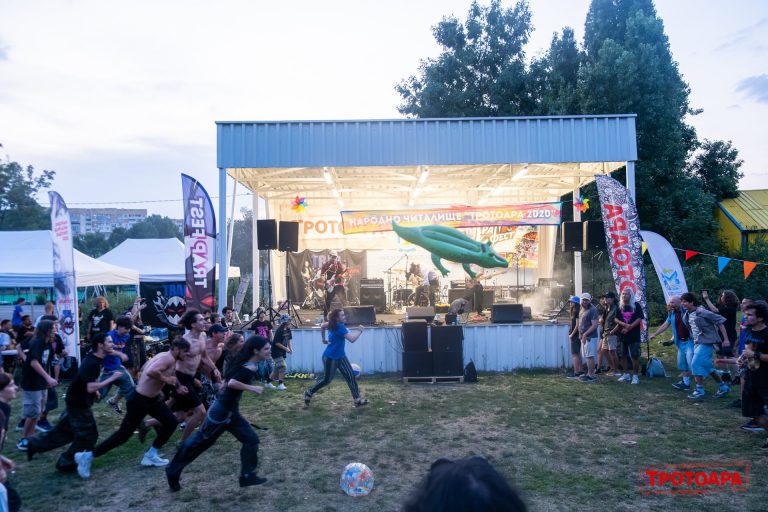
A closer look at the tenth edition A summer evening at TRAP Fest, 27 June 2026. On 14 June, setup…
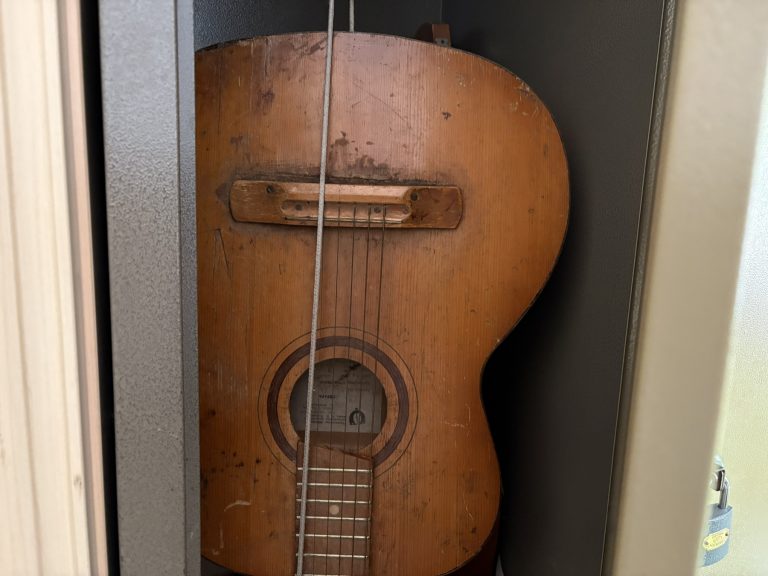
Deyan “Dido” Yankov on the tenth edition of TRAP Fest The guitar is still in the metal cabinet in my…
